Populism Now! by David McKnight
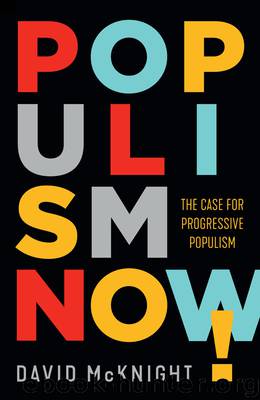
Author:David McKnight
Language: eng
Format: epub
Publisher: NewSouth
The wider context of deregulation
The rise in the use of temporary overseas workers is only the latest development in the wider process of deregulating Australian workplaces which has been going on for over 30 years. This process has eroded what was Australia’s historically unique system of legally regulating pay and working conditions by independent tribunals. This system was grounded in Australia’s Constitution, which gives the federal government the power to settle major industrial disputes. After Federation, Australian governments set up a series of labour courts and tribunals with the power to intervene in industrial disputes and to create legally enforceable industrial awards which established minimum standards.
Sometimes the various industrial courts and tribunals tried to restrain improvements in conditions and pay. But the strength of trade unionism and workers’ struggle, particularly after the Second World War, enabled steady advances in achieving holiday pay, sick leave, and a myriad of other changes which humanised the workplace. Combined with the major parties’ post-war agreement that full employment was a primary goal in regulating business and workplaces, Australian workers achieved a great deal. However, in the late 1970s, the Australian corporate elite joined a global conservative backlash against both the strength of the unions and the idea of centralised wage fixing. Encouraged by the victories of British Prime Minister Margaret Thatcher and US President Ronald Reagan, they were happy to assume the idea of a ‘natural rate’ of unemployment.
As part of this process, Australian corporations, led by the mining and banking sectors, demanded greater ‘flexibility’ in the labour market. Flexibility meant deregulating many of the protections and rights for workers, but tighter regulation of trade unions and collective bargaining. Their argument was the famous – now becoming infamous – ‘trickle down’ economics, the central claim of which is that the benefits of flexible labour markets would trickle down to workers via higher wages and lower unemployment. But this has not occurred. Since the late 1970s, the share of national income going to labour rather than business has declined.29 In recent years, income growth for workers has slowed rapidly. In 2013–14 Australia had negative real wage growth for two consecutive quarters.30 In 2016 Australia saw the weakest wage growth since 1998.31
We have also seen a radical transformation in the working lives of many Australians. Jobs are less secure and regular income is less reliable. The increase in inequality in Australia (discussed in chapter 2) is partly due to this deregulation of Australia’s workplaces and to the rise of what experts call the ‘non-standard model of employment’. That’s not the view of a wild-eyed leftie but that of the economic policy makers at the OECD, an organisation of the world’s richest industrial nations. One of its recent reports points out that in previous years, a rise in employment would reduce inequality but that now this has been ‘undercut by the gradual decline of the traditional, permanent, nineto-five job in favour of non-standard work – typically part-time and temporary work and self-employment’.32 Four Australian experts in industrial
Download
This site does not store any files on its server. We only index and link to content provided by other sites. Please contact the content providers to delete copyright contents if any and email us, we'll remove relevant links or contents immediately.
| Anthropology | Archaeology |
| Philosophy | Politics & Government |
| Social Sciences | Sociology |
| Women's Studies |
The Secret History by Donna Tartt(19503)
The Social Justice Warrior Handbook by Lisa De Pasquale(12310)
Thirteen Reasons Why by Jay Asher(9152)
This Is How You Lose Her by Junot Diaz(7089)
Weapons of Math Destruction by Cathy O'Neil(6498)
Zero to One by Peter Thiel(5962)
Beartown by Fredrik Backman(5961)
The Myth of the Strong Leader by Archie Brown(5636)
The Fire Next Time by James Baldwin(5607)
How Democracies Die by Steven Levitsky & Daniel Ziblatt(5350)
Promise Me, Dad by Joe Biden(5242)
Stone's Rules by Roger Stone(5205)
A Higher Loyalty: Truth, Lies, and Leadership by James Comey(5099)
100 Deadly Skills by Clint Emerson(5041)
Rise and Kill First by Ronen Bergman(4918)
Secrecy World by Jake Bernstein(4907)
The David Icke Guide to the Global Conspiracy (and how to end it) by David Icke(4863)
The Doomsday Machine by Daniel Ellsberg(4644)
The Farm by Tom Rob Smith(4619)
